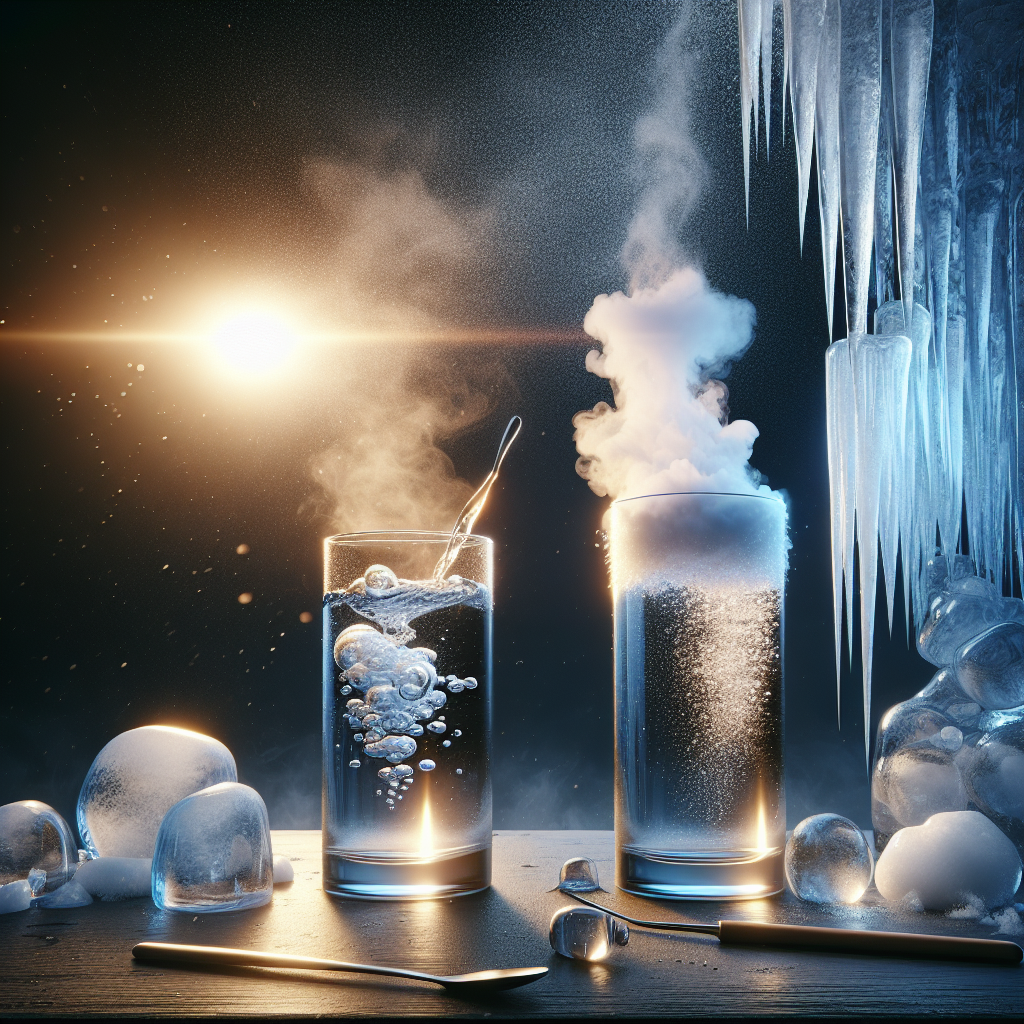
"Hot water can freeze faster than cold water"
It may sound counterintuitive, but hot water can indeed freeze faster than cold water under certain conditions. This mind-bending phenomenon has puzzled scientists for centuries and is known as the Mpemba effect, named after Tanzanian student Erasto Mpemba who observed it in the 1960s. His curious observation was that hot ice cream mix froze faster than a cold one, a claim that initially met skepticism but later garnered scientific interest.
One of the theories explaining this unexpected behavior involves evaporation. Hot water evaporates at a faster rate, reducing the overall volume of liquid that needs to freeze. Moreover, the evaporation process can lead to faster cooling, allowing the remaining water to reach 0°C more quickly. Another explanation lies in the convection currents created in hot water; these currents can speed up the heat loss compared to cold water that lacks such convection.
Though not always easy to replicate, the Mpemba effect serves as a fascinating reminder that nature can surprise us in unexpected ways. Whether you’re boiling water for pasta or learning about the quirks of freezing, this curious case encourages us to explore beyond the surface of scientific principles, challenging what we take for granted and pushing us toward deeper understanding.